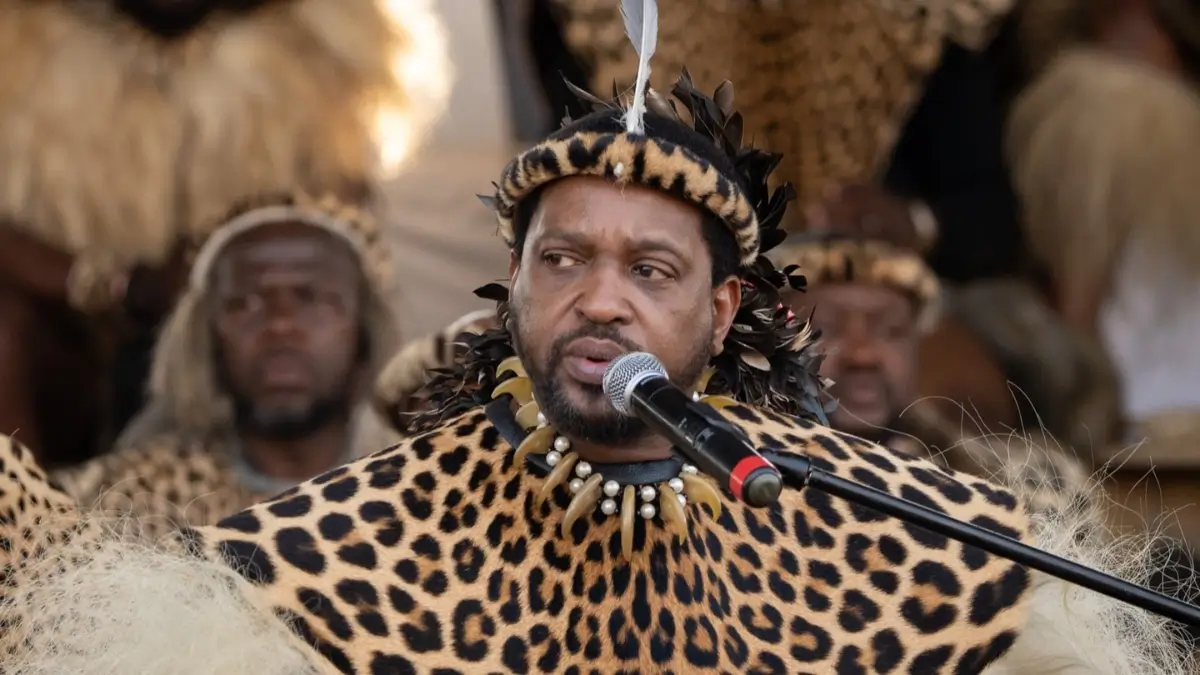
Zulu King Misuzulu kaZwelithini has announced plans to campaign for the renaming of KwaZulu-Natal to KwaZulu, reigniting a contentious national debate over identity, history, and constitutional authority. The proposal, made during commemorations of the Battle of Isandlwana in Nquthu last week, has drawn sharp criticism from cultural and political analysts who argue that removing “Natal” from the provincial name misrepresents the region’s complex past. The renewed debate matters now because any formal name change would require national consultation and could set a precedent affecting other provinces.
The proposal has also attracted attention beyond KwaZulu-Natal, including in Gauteng, where similar debates over place names, heritage, and identity have played out repeatedly over the past three decades.
ALSO READ: Madlanga Commission Resumes as Next Key Witness to Testify Revealed
King Misuzulu Announces Renaming Campaign
Speaking at the 147th anniversary of the Battle of Isandlwana, King Misuzulu said he intends to begin a campaign to remove “Natal” from the provincial name, arguing that the region was historically known as KwaZulu before colonial intervention.
According to the king, the name “Natal” was imposed during colonisation and does not reflect indigenous identity. He said the area formed part of the Zulu kingdom before colonial boundaries were drawn, and that restoring the name KwaZulu would correct a historical injustice.
The remarks were met with applause from some attendees at the commemoration, but they quickly triggered a broader public backlash once reported nationally.
Analysts Challenge the Historical Basis
Cultural analyst Professor Musa Xulu has strongly disputed the king’s historical claims, warning that the proposed renaming risks oversimplifying and distorting the region’s past.
Xulu said there was never a time when the entire province was known as KwaZulu. He argued that the name KwaZulu-Natal, adopted in 1994, reflects a deliberate and historically grounded compromise.
“The idea that this entire region was once KwaZulu is not supported by history,” Xulu said. “There were multiple kingdoms occupying this space long before colonial rule, including the AmaLala.”
According to Xulu, the name Natal predates the formation of the Zulu kingdom as a unified political entity.
How the Name Natal Entered the Historical Record
Historians trace the name Natal back to 1497, when Portuguese explorer Vasco da Gama arrived along the coast near present-day Durban. He named the area Natal, meaning “birth”, in reference to the birth of Christ.
Xulu said that by the mid-19th century, the region became the Colony of Natal under British rule, after previously being referred to as Natalia by Boer settlers. At the same time, the Zulu kingdom existed separately north of the uThukela River.
“In the latter 1800s, Natal and KwaZulu were two distinct neighbouring entities,” Xulu said. “KwaZulu ceased to exist as a separate territory in 1897 when it was incorporated into Natal.”
Why KwaZulu-Natal Was Chosen in 1994
When South Africa reorganised its provinces after the end of apartheid, the name KwaZulu-Natal was selected to reflect the reunion of two historically separate regions.
According to Xulu, the 1994 renaming acknowledged both pre-colonial and colonial histories without privileging one over the other.
“The current name represents a reunification of two neighbours that had long existed side by side,” he said. “It is more inclusive than either KwaZulu or Natal on their own.”
Critics of the king’s proposal argue that removing “Natal” would erase centuries of layered history and elevate one cultural narrative above others.
Political and Constitutional Implications
While King Misuzulu holds cultural authority as monarch of the Zulu nation, analysts have stressed that he does not have the constitutional power to rename a province.
Any change to a provincial name would require:
- A formal proposal through government structures
- Public consultation processes
- Approval by the provincial legislature
- Ratification at national level
Legal experts note that renaming a province is significantly more complex than changing municipal or street names, particularly given the administrative and economic costs involved.
What This Means for Gauteng Residents
For Gauteng residents, the debate is closely watched because similar renaming disputes have played out repeatedly in the province, including changes to cities, streets and public institutions.
Gauteng has experienced prolonged legal challenges, public protests and community divisions over name changes, highlighting how deeply such decisions affect identity, memory and belonging. Analysts say the KwaZulu-Natal debate could reignite national discussions about how South Africa balances cultural restoration with historical plurality.
The issue also raises questions about who gets to define heritage in a constitutional democracy, a concern that resonates strongly in Gauteng’s diverse and highly urbanised population.
Cultural Identity Versus Historical Pluralism
Critics of the proposed renaming argue that South Africa’s strength lies in acknowledging overlapping histories rather than replacing one with another.
Xulu warned that framing the debate as a simple correction of colonial injustice risks promoting what he described as “unearned cultural supremacy”.
“When King Shaka formed the Zulu kingdom, many communities south of the uThukela River remained outside his rule,” Xulu said. “They maintained good relations, but they were not absorbed.”
He said the current name reflects that complexity more accurately than a singular cultural label.
Public Reaction and Broader Debate
Public reaction to the king’s announcement has been mixed, with some supporting the call as a reclaiming of African identity, while others view it as divisive.
Social media platforms have hosted heated exchanges, with commentators questioning whether the proposal serves present-day social cohesion or reopens unresolved historical wounds.
Political parties have so far responded cautiously, with no formal motions introduced in provincial or national legislatures.
FAQ: Proposed Renaming of KwaZulu-Natal
Can the Zulu king rename the province?
No. The king does not have constitutional authority to rename a province.
What would be required to change the name?
A formal government process including public consultation and legislative approval.
Why is the proposal controversial?
Critics argue it oversimplifies history and marginalises other cultural narratives.
Has KwaZulu-Natal’s name changed before?
Yes. The current name was adopted in 1994 to reflect the merger of Natal and KwaZulu.
Is a name change likely?
At this stage, no formal process has begun.
What Happens Next
There is currently no official proposal before the KwaZulu-Natal legislature or Parliament to rename the province. Analysts expect the debate to continue in public forums rather than formal government processes in the short term.
Whether King Misuzulu’s campaign gains political traction remains uncertain, but the controversy has already reopened long-standing national conversations about history, identity and power in post-apartheid South Africa.
Any move toward renaming would require broad public participation and constitutional compliance, a process that could take years rather than months.