Gauteng faces water crisis as authorities warn residents and municipalities about dangerously high water usage well above sustainable limits. Officials from the Department of Water and Sanitation (DWS) and Rand Water have stressed that without immediate action on consumption, infrastructure, and water management, supply disruptions and stricter restrictions will continue.
What Is Driving the Gauteng Water Crisis?
The phrase “Gauteng faces water crisis” is no longer speculative; it reflects a real, ongoing challenge across South Africa’s economic heartland. Key contributors to this crisis include:
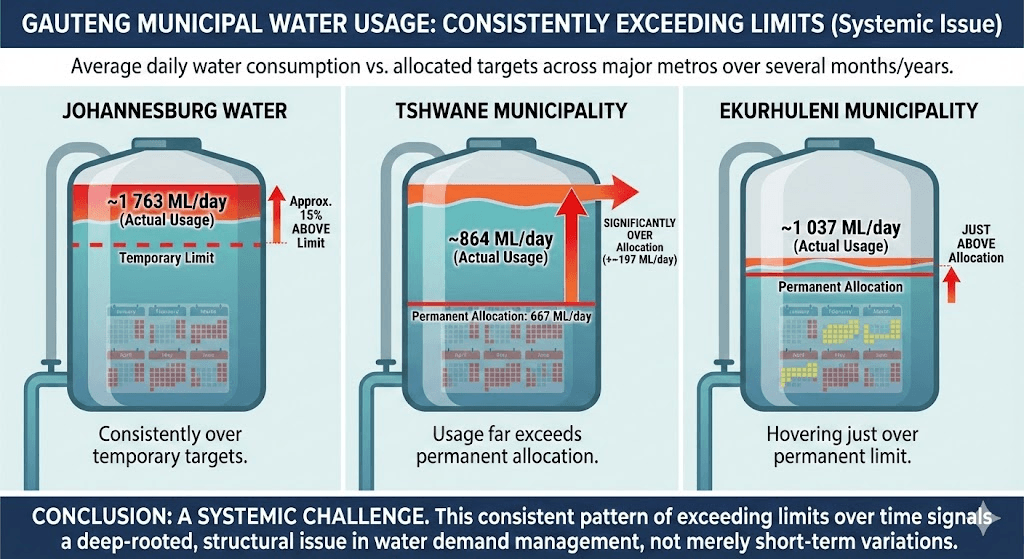
- Overconsumption of water by municipalities — Major metros consistently exceed their licensed water allocations supplied by Rand Water.
- Aging infrastructure and leakages — High levels of non-revenue water (lost through leaks and faults) make it harder to sustain supply.
- Population growth and rising demand — With rapid urbanisation and economic activity, demand outpaces current system capacity.
- Delayed expansion of key supply projects — Lesotho Highlands Water Project Phase 2, which would boost supply, is now expected to only come online around 2028.
According to Rand Water monitoring, combined water use for Johannesburg, Tshwane and Ekurhuleni on 12 January 2026 was about 3 664 ML per day, which exceeds the permanent allocation of 3 045 ML per day and even temporary limits.
Latest Data: Overuse and Municipal Strain
Why Authorities Are Warning Residents
The Department of Water and Sanitation has underscored that the province’s challenges stem largely from unsustainable consumption rather than an absolute lack of water. Sean Phillips, Director-General of the Department, stressed:
“Gauteng needs to bring its per capita consumption down a lot. Overall, Gauteng residents use an average of 279 litres of water per day — this needs to be more in the region of the Western Cape’s average 164 litres.”
This comparison highlights how high daily per-person usage is contributing to pressure on supply systems.
Consequences and Required Actions
Short-Term and Long-Term Solutions
Authorities outline several conditions needed before meaningful improvement can be realised:
- Significant reduction in non-revenue water (NRW) — fixing leaks and preserving water within the system.
- Expansion of storage infrastructure — reservoirs and bulk storage to buffer supply.
- Municipal enforcement of water restrictions — including consumption limits and public compliance.
- Lesotho Highlands Water Project Phase 2 coming online to increase regional supply capacity.
Without these, the risk of elevated water restrictions, outages and system strain remains high.
In summary, Gauteng faces water crisis challenges that stem from consumption patterns, ageing infrastructure, and delayed system enhancements. Coordinated efforts between authorities, residents, and municipalities are essential to prevent more severe shortages and ensure water security for the province’s future.