
Gauteng motorists could be heading into February 2026 with welcome relief at the pumps, as early fuel price data points to another significant cut in diesel and petrol prices, potentially one of the strongest starts to a year in recent memory.
Preliminary figures released by the Central Energy Fund (CEF) show that fuel price recoveries are already building strongly in the first week of January. If current market conditions persist, South Africans may see another sizeable reduction in fuel prices when the official adjustment is announced at the end of the month.
This comes after January 2026 already delivered a cut, easing pressure on households, commuters, taxi operators, and logistics businesses across Gauteng.
ALSO READ: Kempton Park Train Tragedy: Second Death Sparks Public Outcry
Early CEF Data Signals Strong Over-Recoveries
According to CEF data tracking international oil prices and the rand-dollar exchange rate, petrol and diesel are currently over-recovering well above the neutral level, meaning South Africans are paying more than global benchmarks would suggest.
At the start of January, recoveries stood at:
- Petrol 93: over-recovery of around R1.09 per litre
- Petrol 95: over-recovery of around R1.15 per litre
- Diesel 0.05% (wholesale): over-recovery of around R1.49 per litre
- Diesel 0.005% (wholesale): over-recovery of around R1.63 per litre
- Illuminating paraffin: over-recovery of around R1.28 per litre
February 2026 Diesel And Petrol Price Forecast: What Could Happen at the Pumps?
Based on current trends, analysts say South Africa is on track for another fuel price cut in February 2026, with petrol and diesel both benefiting.
If current conditions hold through the rest of January, motorists could see indicative price changes of:
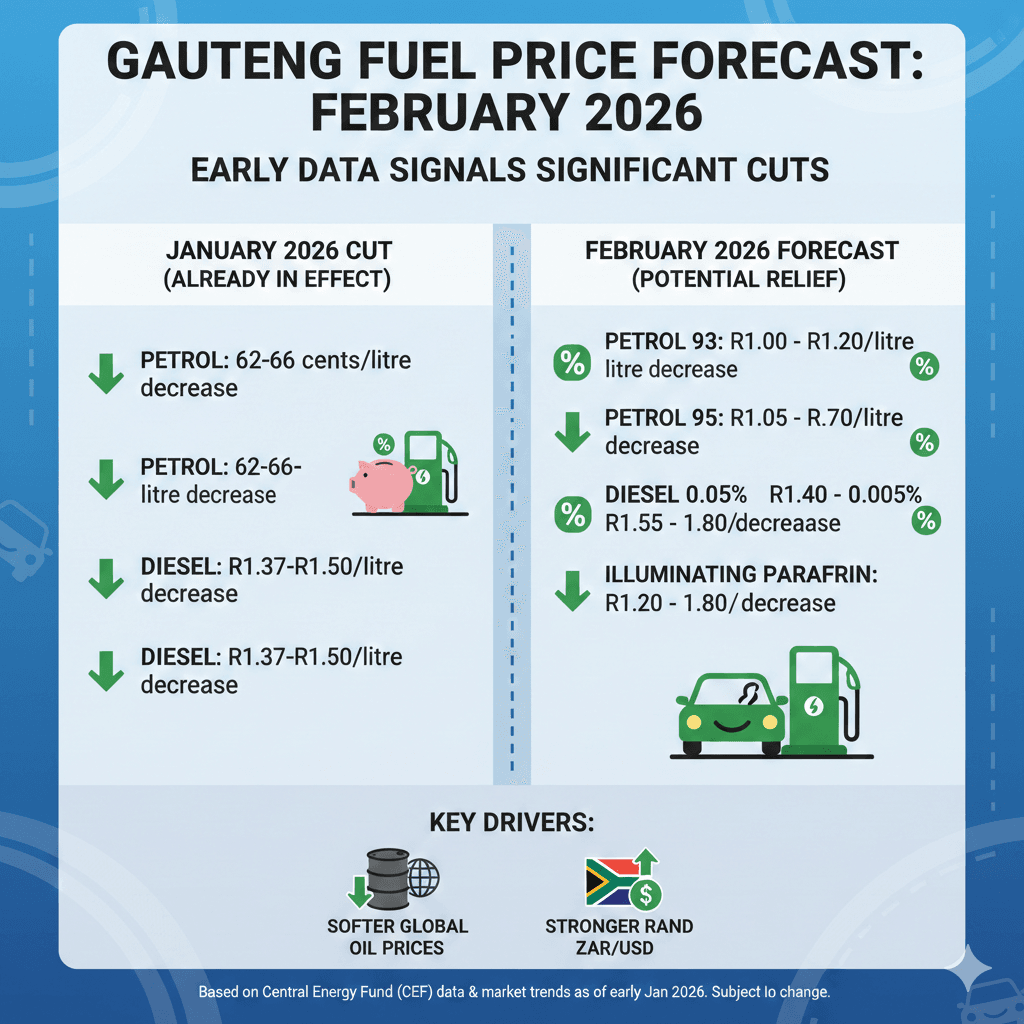
While these figures remain subject to change, they paint a positive picture for Gauteng motorists who rely heavily on daily travel.
Why Fuel Prices Are Moving in Motorists’ Favour
The current over-recovery is being driven by two key forces: softer global oil prices and a remarkably resilient rand.
Global Oil Prices Under Pressure
International oil markets have faced renewed pressure following increased supply expectations and geopolitical developments that have unsettled prices.
Oil briefly dipped below $58 per barrel earlier this month following heightened global tensions and shifts in supply dynamics. While prices later rebounded to above $62 per barrel, analysts say the broader outlook still points toward oversupply in 2026.
“Crude remains caught in a complex dance between heightened geopolitical risk and rising inventory,” said Robert Rennie, Head of Commodity Research at Westpac Banking Corp.
“Higher output and increased flows could see prices trading in the $50 range through the first quarter.”
For South Africa, this global pricing environment helps reduce fuel import costs.
A Stronger Rand Is Doing Heavy Lifting
The other crucial factor is the rand’s continued strength. The currency ended 2025 nearly 13% stronger against the US dollar, marking its best annual performance in 16 years. That momentum has carried into early 2026, contributing approximately 21 cents per litre to the current over-recovery.
While South Africa still faces structural challenges, including low growth and high unemployment, global investors have shown renewed appetite for emerging markets, and South Africa has benefited.
Analysts also point to lower near-term political risk, solid precious metal exposure, and a weaker US dollar as factors supporting the rand.
January’s Cut Set the Tone for 2026
The optimism around February builds on relief already delivered in January.
From Wednesday, 7 January, fuel prices were adjusted downward by:
- Petrol: cut by 62 to 66 cents per litre
- Diesel: cut by R1.37 to R1.50 per litre
For many Gauteng households, this translated into immediate savings on daily commuting, school runs, and business transport costs, a welcome start to the year.
Why February’s Outlook Matters for Gauteng
Fuel prices hit Gauteng particularly hard. The province’s economy depends heavily on road transport, from commuters travelling between metros to taxis, delivery fleets, and logistics hubs keeping businesses moving.
Lower fuel prices can:
- Reduce transport costs for workers
- Ease pressure on food and retail prices
- Improve margins for small businesses and delivery operators
- Offer short-term relief to households already stretched by rising living costs
Even modest fuel price cuts can have ripple effects across the provincial economy.
What Could Still Change Before the Official Announcement?
Despite the positive indicators, caution remains essential. There are still three weeks of trading before the official February fuel price announcement. History has shown that oil prices and currency markets can turn quickly.
A sharp spike in global oil prices or a sudden weakening of the rand could still reduce or even erase the current over-recovery. However, at present, neither scenario appears likely.
What Motorists Should Watch Next
As February approaches, Gauteng motorists should keep an eye on:
- Brent crude oil price movements
- Daily rand-dollar exchange rates
- Updated CEF snapshots in late January
These indicators will confirm whether the current trend holds.
The Bottom Line
If current conditions persist, February 2026 could deliver another meaningful fuel price cut, extending the relief that began in January. While nothing is official yet, the numbers strongly favour motorists, especially those in Gauteng who depend on fuel for work and daily life.
Fuel prices affect everything from your commute to the price of groceries. Stay informed, plan ahead, and follow Gauteng News for confirmed fuel price announcements, expert breakdowns, and practical tips on how price changes impact your daily costs.