The conflict in the Middle East escalated again on Monday after Iran launched missiles toward Israel following the appointment of a new Iranian supreme leader. The latest developments include new regional attacks, rising oil prices above $100 per barrel, and increased military activity across Lebanon and the Gulf. Global markets reacted immediately, with Asian stock markets falling sharply in early trading.
The intensifying conflict between Israel, Iran, and their allies is now spreading across several countries in the region. The developments are drawing international attention because of their potential impact on global security, oil supply, and international diplomacy.
ALSO READ: Middle East War Latest: Overnight Updates and Breaking Developments
New Iranian Leadership and Regional Tensions
Iran has named Mojtaba Khamenei as the country’s new supreme leader following the death of his father, Ali Khamenei. The Assembly of Experts selected him to lead the Islamic Republic, according to Iranian state media.
Senior Iranian officials described the appointment as legitimate and welcomed the transition. Iran’s Revolutionary Guards pledged allegiance to the new leader shortly after the announcement.
The appointment immediately heightened tensions. Israel’s military had previously warned it would target any successor to Iran’s leadership structure if the conflict continued. Iranian-backed groups across the region also responded publicly, signalling support for the new leadership.
Analysts say the leadership change comes at a sensitive moment in the conflict, with several countries in the region already involved in military exchanges.
Israel and Iran Exchange Missile Strikes
Shortly after the announcement of Iran’s new leader, Iranian missiles were fired toward Israel, according to Iran’s state broadcaster.
Israeli authorities confirmed that their military responded with new strikes targeting infrastructure linked to the Iranian government.
Officials said the strikes were aimed at military installations and strategic assets.
Emergency services in Israel reported that at least one civilian woman was injured during the missile attacks.
The exchanges represent one of the most confrontations between the two countries during the current conflict.
Gulf Region Sees New Attacks
The conflict has expanded beyond Israel and Iran.
Several Gulf countries reported attacks or attempted strikes:
- Bahrain’s health ministry said an Iranian drone strike wounded 32 civilians on the island of Sitra.
- Four of the injured were reported to be in serious condition.
- Qatar’s defence ministry said its air defence systems intercepted a missile targeting Doha.
- Saudi Arabia reported that a projectile killed two people and wounded 12 others.
Explosions were also reported in parts of the Gulf region, raising concerns that the conflict could spread further across strategic shipping and oil routes.
Fighting Intensifies in Lebanon
Military activity has also increased along the Lebanon border.
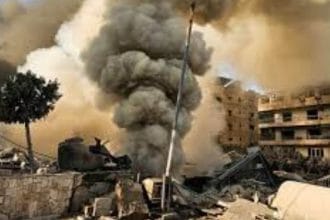
The Israeli military confirmed it carried out strikes in the Lebanese capital Beirut targeting infrastructure linked to Hezbollah.
Hezbollah said it had engaged Israeli forces who had entered eastern Lebanon by helicopter during an overnight operation.
Sources within Hezbollah claimed the group downed an Israeli helicopter in the area, though the Israeli military has not confirmed that claim.
Lebanon remains one of the most volatile fronts in the conflict because Hezbollah is a key ally of Iran.
United States Evacuates Embassy Staff
The United States has ordered non-emergency government staff and family members to leave Saudi Arabia due to security risks.
The US State Department said the decision was based on concerns about potential attacks in the region.
At the same time, the US military confirmed the death of another American service member injured during retaliatory strikes earlier in the conflict.
According to the Pentagon, seven US military personnel have now died since the war began.
Six were killed in a drone attack on a military base in Kuwait.
Oil Prices Surge Above $100 Per Barrel
Global oil markets reacted sharply to the escalating conflict.
Both major oil benchmarks:
- Brent crude
- West Texas Intermediate (WTI)
rose above $100 per barrel for the first time in nearly four years.
Energy analysts say fears of supply disruptions in the Gulf are driving the increase.
Since the war began:
- WTI crude prices have risen more than 75%
- Brent crude has increased more than 60%
Higher oil prices could affect global inflation and transport costs.
Global Markets React
Stock markets in Asia fell sharply as investors reacted to the surge in oil prices and geopolitical uncertainty.
Major indexes in Japan and South Korea declined in early trading as investors shifted toward safer assets.
Financial analysts say prolonged conflict in the Middle East could affect global economic stability because the region supplies a significant portion of the world’s oil.
Human Rights Concerns Raised
Human Rights Watch has accused Israel of using white phosphorus over residential areas in southern Lebanon.
White phosphorus is a chemical substance that ignites when exposed to oxygen. It can cause severe burns and respiratory damage.
The organisation said the substance was used in the Lebanese town of Yohmor.
Israel has not publicly responded to the allegations.
Human rights groups say the use of such weapons in civilian areas could violate international law.
What This Means for Gauteng Residents
Although the conflict is taking place thousands of kilometres away, it could still affect South Africans.
Gauteng residents may see indirect impacts through:
- Fuel prices increasing due to rising global oil costs
- Transport and logistics costs rising across supply chains
- Financial market volatility affecting global investments
- Inflation pressures if energy prices remain high
South Africa imports most of its crude oil, meaning global oil shocks often translate into higher domestic fuel prices.
Economic analysts say prolonged instability in the Middle East could place pressure on energy markets for months.
FAQ’s
Why is the Middle East conflict escalating now?
The conflict intensified following direct exchanges between Israel and Iran, as well as the appointment of a new Iranian supreme leader, which has raised political and military tensions in the region.
Which countries are currently involved?
The main confrontation involves Israel and Iran, but the conflict has spread across Lebanon, Bahrain, Qatar, Saudi Arabia and other Gulf states through allied groups and missile or drone attacks.
Why are oil prices rising?
The Middle East is responsible for a large share of global oil production. When conflict threatens supply routes or production facilities, markets react by pushing prices higher.
Could the conflict spread further?
Security analysts say the risk remains high because several regional allies are involved, including Hezbollah in Lebanon and other Iran-aligned groups.
How could this affect South Africa?
South Africa may feel economic effects such as higher fuel prices and inflation if oil markets remain unstable.
What Happens Next
Diplomatic efforts are continuing as international leaders attempt to prevent further escalation.
French President Emmanuel Macron confirmed he spoke with Iran’s president and urged restraint and an end to attacks on neighbouring countries.
Military operations, however, continue across several fronts.
The next phase of the conflict will likely depend on whether further strikes occur between Israel and Iran, and whether regional powers intervene more directly.
Global markets, governments and humanitarian organisations are closely monitoring developments as the situation evolves.