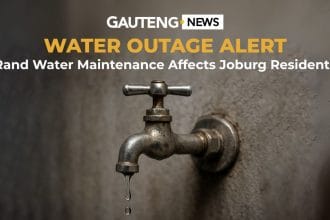
The Joburg water outage remains a major concern for residents across Johannesburg after the Zuikerbosch incident disrupted Rand Water’s bulk supply. Johannesburg Water has confirmed that bulk pumping has stabilised, marking the start of a gradual reservoir recovery process. However, low pressure and intermittent supply continue in several areas.
Residents should continue using water sparingly while the system recovers.
What caused the Joburg water outage?
The outage follows an operational incident at Rand Water’s Zuikerbosch system, which supplies bulk water to Johannesburg and surrounding metros. The disruption affected pumping capacity and led to falling reservoir levels across the city.
According to Johannesburg Water, Rand Water has now stabilised bulk pumping. This recovery phase allows water to move progressively into affected municipal reservoirs.
Current pumping status after the Zuikerbosch water outage
Johannesburg Water confirmed the following pump station performance as of the morning update:
- Eikenhof Pump Station: 100 percent full load pumping
- Zwartkopjes Pump Station: 100 percent full load pumping
- Palmiet Pump Station: Approximately 95 percent load
This improvement signals the start of system recovery. However, reservoir replenishment and network balancing take time, especially in high-lying areas.
Areas most affected by the Joburg water outage
Despite improved bulk supply, several Johannesburg Water systems remain low or critically low. Residents in these areas continue to experience low pressure or no water.
Sandton systems
- Bryanston
- Illovo
- Other direct feed areas within Sandton
Midrand systems
- Erand
- Grand Central
- President Park
- Rabie Ridge
- Diepsloot
- Steyn City
Central systems
- Yeoville
- Berea
- South Hills Pump Station
- Alexander Park
- Hursthill
- Linksfield
Johannesburg Water warns that intermittent supply may also affect other areas as the network stabilises.
What residents should expect next
While bulk pumping has stabilised, reservoir recovery will be gradual. Residents should expect:
- Low water pressure
- Intermittent supply
- Slow restoration, especially in elevated areas
Johannesburg Water continues to monitor reservoir levels and system performance closely. Full normalisation depends on sustained bulk supply and balanced consumption.
Also Read: Johannesburg Pushes Gauteng Water Usage Past 1700 Megalitres Daily
Interventions in place to manage the Joburg water outage
Johannesburg Water has activated contingency measures to reduce the impact of the outage:
- Continuous monitoring of reservoirs and system performance
- Controlled throttling and temporary closures to preserve capacity
- Deployment of alternative water supply where required
- Ongoing engagement with Rand Water and ward councillors
Residents are urged to avoid non-essential water use to support faster recovery.
What you should do during the Zuikerbosch water outage recovery
To help stabilise the system:
- Store water safely when supply returns
- Avoid watering gardens and washing vehicles
- Limit household water use to essential needs
- Report leaks immediately to Johannesburg Water
Responsible usage plays a direct role in speeding up reservoir recovery.
Is the Joburg water outage over?
No. Bulk pumping has stabilised, but reservoir recovery remains in progress. Intermittent supply will continue in affected areas.
Why is recovery taking so long?
Reservoirs refill gradually. High-lying areas and direct feed systems take longer to stabilise.
Which areas are still without water?
Parts of Sandton, Midrand, and central Johannesburg remain most affected. Other areas may experience intermittent disruptions.
Is this linked to load shedding?
No. The outage relates to the Zuikerbosch water outage and bulk supply constraints, not electricity supply.
Where can I get official updates?
Follow Johannesburg Water’s official channels and ward communications for verified updates.
Also Read: Load Reduction Schedule for 26 to 31 January 2026