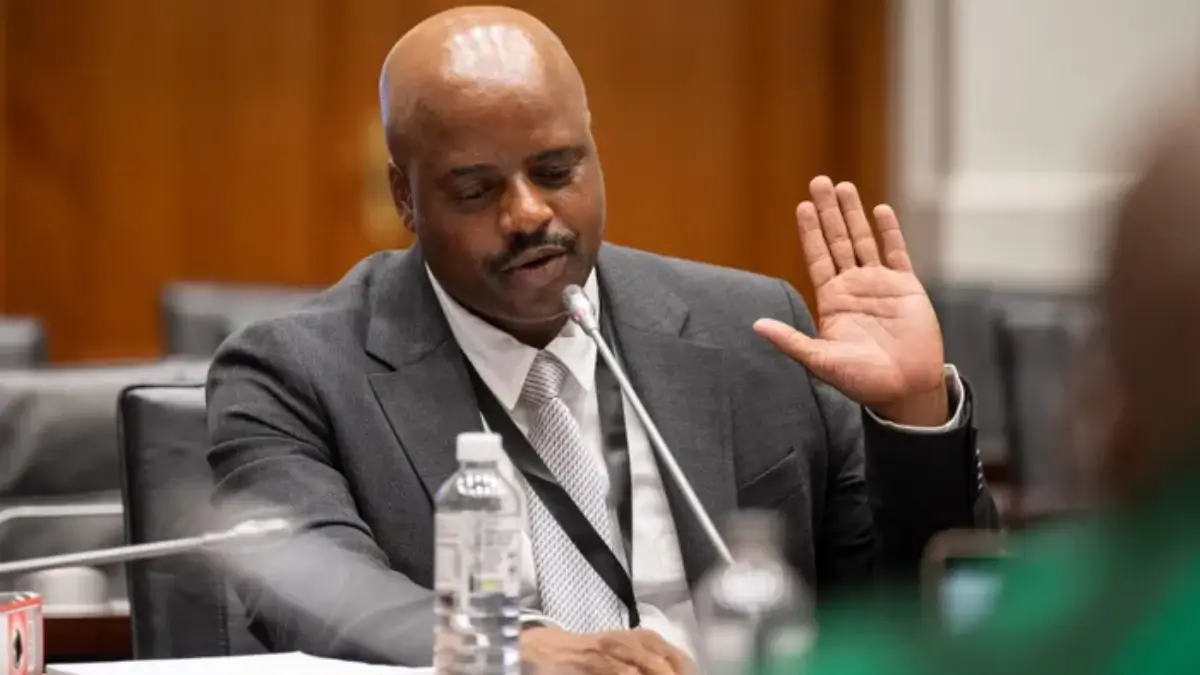
Suspended Ekurhuleni Metropolitan Police Department (EMPD) deputy chief Julius Mkhwanazi has denied any involvement in the murder of Marius van der Merwe, also known as Witness D, whose killing, days after testifying before the Madlanga Commission of Inquiry, intensified scrutiny of police accountability. Speaking before Parliament on Thursday, Mkhwanazi rejected claims linking him to the hit-style shooting in Brakpan, Gauteng, saying the allegations have placed his family at risk and unfairly branded him a “killer police”. The case matters now because it sits at the centre of a widening probe into alleged corruption, witness safety, and command responsibility within Gauteng’s metro policing.
Mkhwanazi appeared before Parliament’s ad hoc committee at the Good Hope Chamber in Cape Town, where he reiterated denials he previously made to the Madlanga Commission. The commission is investigating criminality, political interference, and corruption within parts of the justice system.
Van der Merwe was shot dead at his Brakpan home on 5 December 2025, in front of his family, in what police described as a targeted attack. The killing occurred one day after Mkhwanazi concluded his testimony at the commission on 4 December.
ALSO READ: KZN Government Backs Nhlanhla Mkhwanazi for Second Term as Police Chief
Testimony and The Timeline Under Scrutiny
Van der Merwe, a former EMPD officer and private security firm owner, testified before the Madlanga Commission in November 2025 under the identifier Witness D. He alleged that Mkhwanazi ordered the disposal of the body of a suspect who had been tortured and killed by EMPD officers during a 2022 operation. According to his testimony, the body was dumped in a dam to conceal the crime.
On Thursday, Mkhwanazi told MPs he learned of van der Merwe’s death while reading a newspaper at an airport. He described the news as “very disturbing and hurting”, saying it was the first time he had encountered claims linking the murder to his testimony.
“When the flight was delayed, I decided to read a newspaper,” he said, adding that he did not engage with social media and was taken aback by the reporting.
He asked the committee to examine van der Merwe’s written statement to the commission. “I don’t know Witness D, and he even said in his statement that he doesn’t know me,” Mkhwanazi told MPs. “I started to know Witness D after his murder, but I don’t know him physically. I never saw him.”
Presence at The 2022 Scene
Mkhwanazi acknowledged that he was present at the scene of the 2022 incident cited by van der Merwe, but denied any wrongdoing or issuing instructions to dispose of a body.
“I woke up, and I went there,” he said, explaining that his presence was to celebrate the recovery of stolen goods by EMPD officers.
He rejected the allegation that he ordered any unlawful acts. “I never issued an instruction. I don’t know that person, and he doesn’t know me,” he said.
Counter-allegations Against Witness D
In his testimony, Mkhwanazi levelled serious accusations against van der Merwe, claiming Witness D was involved in violent crimes unrelated to the commission’s focus.
“I have an affidavit of a white person complaining that they have been tortured by this Witness D,” Mkhwanazi told the committee. He further alleged that van der Merwe had been involved in the killing of illegal miners.
These claims were presented as part of Mkhwanazi’s broader argument that the narrative linking him to the murder was incomplete and damaging.
Safety Concerns and Family Impact
Mkhwanazi told MPs that the association of his name with van der Merwe’s death had deeply unsettled his family. He said the climate of suspicion had restricted his movement and raised fears for his safety.
“It gives me worries now. I can’t even move out of the house because I am being seen as the killer police,” he said. “Where I go, I kill people, I don’t know for what.”
He added that his concerns were heightened after his attorney was recently shot, although no details were provided to the committee about that incident.
“You’ll be judged by social media,” Mkhwanazi said, “but it is worrying when people are dying like this, and you are quiet.”
A Pattern of Allegations
The murder denial unfolded against a backdrop of multiple investigations and disciplinary actions involving the deputy chief.
Mkhwanazi faces allegations that he unlawfully facilitated the installation of blue lights on vehicles owned by businessman Vusimuzi “Cat” Matlala without authorisation from the City of Ekurhuleni. According to testimony and documents before the commission, the allegations relate to two memorandums of understanding he signed in October 2021, which allegedly created an unofficial relationship between the EMPD and Matlala’s companies, Cat VIP Protection Services and Medicare24 Tshwane District.
As a result, Mkhwanazi was suspended in February 2023, and the matter was referred to the Independent Police Investigative Directorate (Ipid). He returned to work on 24 May 2023. Ipid released its findings in September 2023.
He was also investigated by the Ipid for allegedly shielding three EMPD officers accused of crimes, including copper theft.
Further claims presented to the Madlanga Commission allege that Mkhwanazi approved 55 irregular promotions within three months of his appointment as deputy chief in December 2023. Questions have also been raised about the legality of his appointment, with EMPD chief Isaac Mapiyeye and former Ekurhuleni city manager Imogen Mashazi testifying that Mkhwanazi assumed the role without completing the mandatory competency assessment.
Mkhwanazi was suspended for a second time in November 2025.
What This Means for Gauteng Residents
For residents of Ekurhuleni and the wider Gauteng region, the case underscores ongoing concerns about accountability within metro police services. The killing of a key commission witness has sharpened focus on witness protection, internal oversight, and the speed at which allegations against senior officers are investigated. The outcome of parliamentary scrutiny and commission findings will influence public confidence in local law enforcement and determine whether systemic reforms follow.
Key facts at a glance
- Victim: Marius van der Merwe, former EMPD officer, known as Witness D
- Killed: 5 December 2025, Brakpan, Gauteng
- Context: Testified before the Madlanga Commission in November 2025
- Allegations: Claimed Mkhwanazi ordered the disposal of a body after a 2022 incident
- Response: Mkhwanazi denies involvement, denies knowing van der Merwe
- Status: Mkhwanazi suspended; multiple investigations ongoing
FAQ
Who was Witness D?
Marius van der Merwe was a former EMPD officer and private security firm owner who testified before the Madlanga Commission under the identifier Witness D.
Why is the timing of the murder significant?
He was killed a day after Julius Mkhwanazi concluded his testimony before the commission, raising questions about witness safety.
What is Mkhwanazi accused of?
He faces allegations ranging from involvement in unlawful police actions to facilitating unauthorised blue lights and irregular promotions. He denies wrongdoing.
What role is Parliament playing?
Parliament’s ad hoc committee is examining testimony related to the commission’s work and broader issues of accountability.
What investigations are ongoing?
Matters involving Mkhwanazi have been referred to Ipid, and the Madlanga Commission continues to hear evidence.
What Happens Next
The ad hoc parliamentary committee is expected to continue hearings as it assesses evidence emerging from the Madlanga Commission. The commission itself is still taking testimony, with findings and recommendations anticipated later this year. Separately, outcomes from Ipid investigations will determine whether criminal charges or further disciplinary steps follow. For now, Mkhwanazi remains suspended, and the murder of Witness D remains under active investigation.