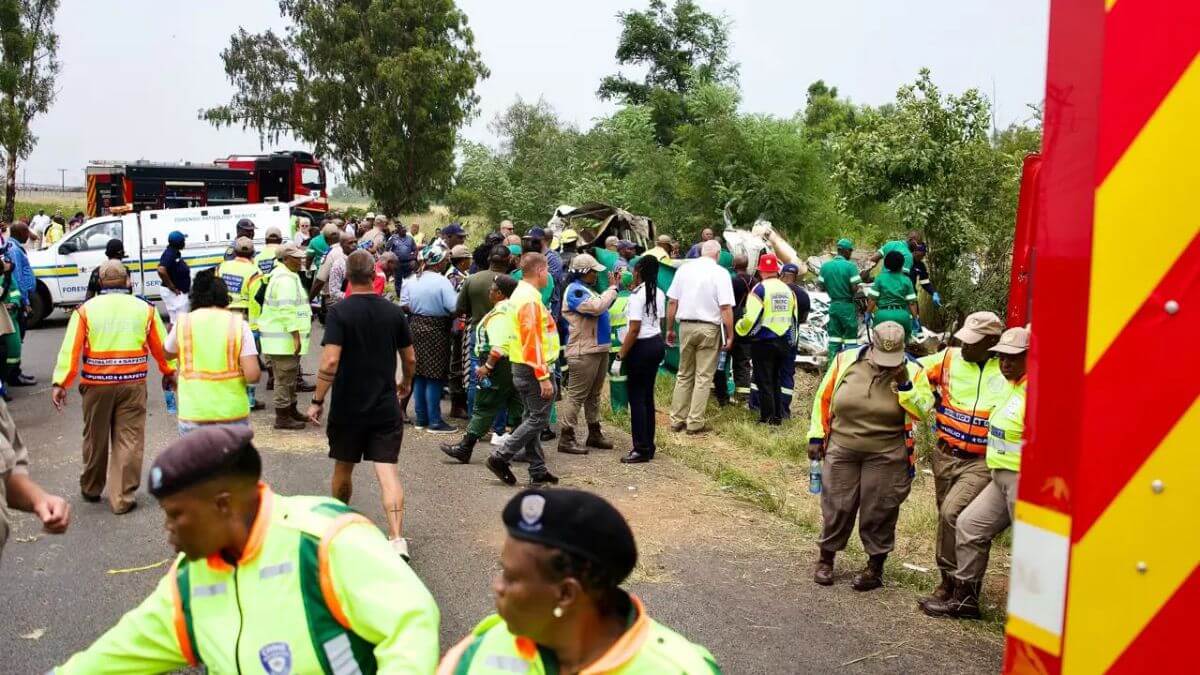
Scholar transport regulations sit at the centre of national debate after a devastating crash in Vanderbijlpark claimed the lives of 13 learners. The tragedy, now widely referred to as the incident where 13 learners die at Vaal transport accident, has exposed serious gaps in safety oversight, enforcement, and accountability within South Africa’s private scholar transport sector.
Learners from several primary and secondary schools were travelling in a Toyota Quantum when the vehicle collided head-on with a truck. The incident has triggered responses from national leadership, provincial departments, and transport authorities, all calling for immediate reform.
What Happened in the Vanderbijlpark Scholar Transport Crash
Preliminary investigations reveal a sequence of reckless actions that ended in catastrophe.
According to Gauteng Education MEC Matome Chiloane, one of the drivers involved had been reprimanded only a week earlier for dangerous driving behaviour. Reports indicate that the Quantum attempted to overtake four vehicles before entering the oncoming lane and colliding with a truck.
Gauteng police spokesperson Colonel Mavela Masondo confirmed key details:
- The initial death toll at the scene stood at 11, later rising to 13
- Four learners and the taxi driver were taken to Sebokeng Hospital
- One learner and the truck driver were taken to Kopanong Hospital
The truck driver reportedly tried to swerve but had no space to avoid impact, according to Gauteng Premier Panyaza Lesufi.
Government Leaders Call for Stricter Scholar Transport Regulations
The scale of the tragedy has prompted strong political response at both provincial and national level.
Premier Lesufi stated that the private scholar transport sector has operated without sufficient oversight for too long. He confirmed plans for urgent engagement between the Departments of Education and Transport to review current scholar transport regulations and enforcement mechanisms.
President Cyril Ramaphosa echoed this stance, describing the deaths as a national loss.
“Our children are the nation’s most precious assets,” Ramaphosa said. “We must do all we can to protect the lives of learners.”
His comments gained further weight as the tragedy occurred on the same day the South African Human Rights Commission released a report highlighting long-standing safety failures in learner transport.
Why Scholar Transport Regulations Remain a Safety Concern
Despite existing frameworks, enforcement gaps continue to place learners at risk.
Current challenges include:
- Poor vehicle roadworthiness checks
- Inconsistent driver vetting and training
- Weak monitoring of private operators
- Limited consequences for repeat offenders
In Gauteng alone, thousands of learners rely on private transport daily. Data from road safety advocacy groups shows that minibus taxis remain among the highest-risk vehicles during peak school travel hours.
Without stronger oversight, unsafe practices continue unchecked, often until tragedy strikes.
The Human Cost Behind the Statistics
Beyond policy discussions, families and communities face irreversible loss.
One mother who lost two children collapsed at the scene, pleading to see their bodies. Emergency workers attempted to assist as she cried out in grief.
Health MEC Nomantu Nkomo Ralehoko confirmed that injured learners are receiving treatment in public hospitals and that counselling services are being provided to affected families.
School communities across the Vaal have since held vigils and memorial services, highlighting the deep emotional impact of the crash.
What Changes Are Expected to Scholar Transport Regulations
Authorities now face pressure to move from statements to action.
Expected focus areas include:
- Mandatory registration of all scholar transport operators
- Regular vehicle inspections linked to operating permits
- Stricter penalties for reckless driving and overloading
- Joint enforcement operations between education and transport departments
Transport safety experts have also urged parents to demand proof of compliance before placing learners in private transport.