Loadshedding Returns to South Africa? What the Latest Data Says
Loadshedding sits at the centre of South Africa’s economic outlook and daily planning. The good news looks real. Eskom reports fewer Load-Shedding days, better plant performance, and a summer outlook that targets no cuts through March 2026.
Yet experts still warn about a comeback risk. They point to grid access, transmission investment, and market reform pace.
Where South Africa Stands Right Now
Eskom’s 2025/26 Summer Outlook briefing states: “No load-shedding is expected over the 2025/26 summer period.”
It also states that no load-shedding is expected from 1 September 2025 to 31 March 2026 if unplanned losses stay below 15GW.
Recent performance trends back up the optimism.
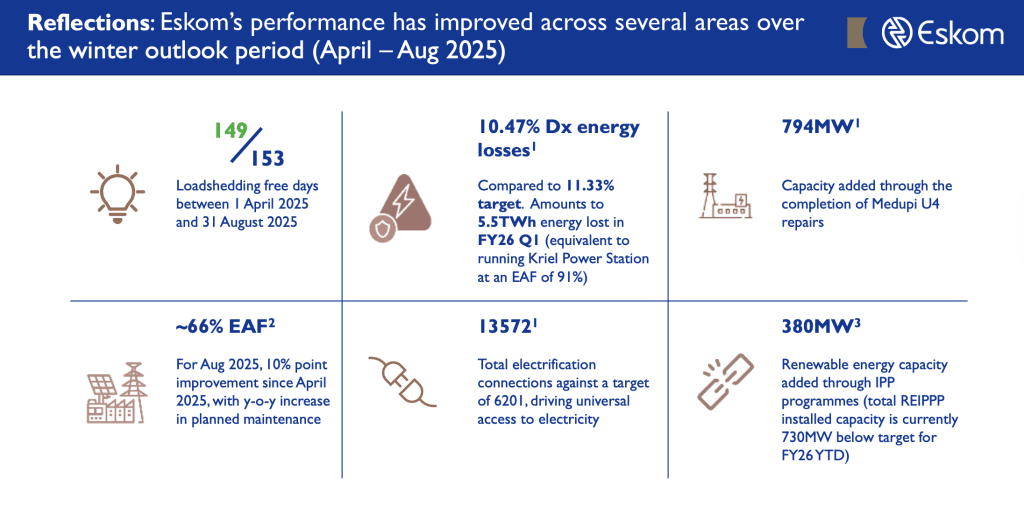
- Eskom says loadshedding dropped from 329 days in FY24 to 13 days in FY25.
- Eskom says EAF improved from 55% in FY23 to 60.6% in FY25.
- Eskom says diesel spend fell from R30bn in FY23 to R17.7bn in FY25.
- CSIR reports only 749 GWh shed in H1 2025, versus 4,126 GWh in H1 2024.
Why “Load-Shedding Returns to South Africa” remains a live question
Short runs without cuts do not remove structural risks. South Africa still needs new generation and grid connections at speed. It also needs rules that unlock investment.
Transmission and grid access worries
Anton Eberhard, emeritus professor at UCT’s Power Futures Lab, links the risk to transmission governance. He says reforms aim for an independent operator outside Eskom.
“The intention of the Electricity Regulation Act Amendments is the creation of an independent Transmission System Operator (TSO) outside of Eskom.”
He also warns about the impact of Eskom keeping control of transmission.
“If Eskom holds on to transmission, I predict continued constraints for its competitors connecting to the grid and the return of load-shedding as insufficient new generation comes online.”
These concerns matter because new power projects often wait for grid capacity. Delays raise the risk of shortfalls during breakdown spikes.
Also Read: The Difference Between Loadshedding and Load Reduction Explained
What the law and market reform try to change
South Africa passed the Electricity Regulation Amendment Act in 2024. The Act defines a “Transmission System Operator SOC Ltd”.
Legal design supports a shift toward a more open electricity market structure.
In plain terms, the reform agenda focuses on:
- Non-discriminatory grid access for generators.
- Clear market roles like system operator and market platforms.
- Faster connection of new capacity, including private projects.
Those design choices align with the investor case Eberhard makes. He argues that a standalone transmission entity attracts capital more easily than a debt-heavy holding structure.
What to watch for in 2026
Operational triggers that can bring cuts back
Reuters reported a return of Stage 3 cuts in March 2025 after failures at key plants. That pattern still applies today.
Watch these pressure points:
- Unplanned outages rising toward Eskom’s 15GW threshold.
- Delays returning units from long outages.
- Extreme demand days paired with low reserves.
- Slower-than-needed transmission build and connections.
Household and business steps that reduce exposure
Practical actions help even during “good” periods.
- Test inverters and batteries monthly.
- Shift heavy use to off-peak hours.
- Replace high-draw appliances first, like old geysers.
- Track local schedules and municipal alerts.
Key insights summary
- Eskom’s official outlook targets no Load-Shedding through March 2026, under defined outage limits.
- CSIR data shows a large drop in energy shed in early 2025.
- Experts still flag transmission independence and grid expansion as the long-term hinge point.
FAQs
Is Load-Shedding back in South Africa right now?
Eskom’s summer outlook projects no cuts through to 31 March 2026 if outages stay controlled.
What would trigger Load-Shedding again?
A sharp rise in unplanned outages, plus weak reserves, often triggers cuts. Reuters described that dynamic during the March 2025 return.
Why do transmission reforms matter?
New generators need grid access. If access stays slow or contested, new capacity connects later.
What does the CSIR data show?
CSIR reports 749 GWh shed in H1 2025, down from 4,126 GWh in H1 2024.
What is the expert warning in simple terms?
Eberhard warns grid control inside Eskom can slow investment and competition. That raises return risk.